Transactive Memory Systems
https://tegorman13.github.io/ccl/tms.html
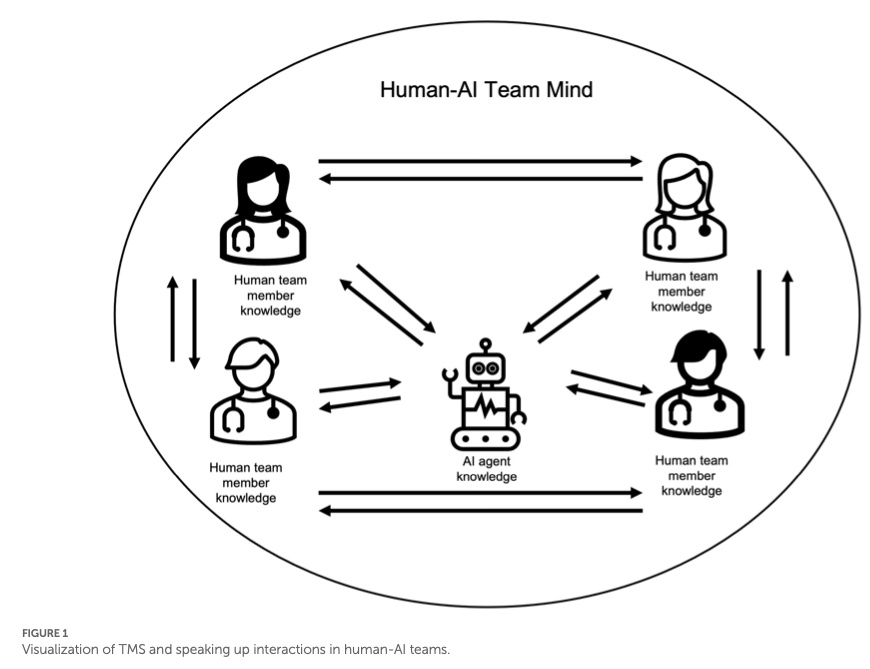
Human-AI teaming: Leveraging transactive memory and speaking up for enhanced team effectiveness.
Bienefeld, N., Kolbe, M., Camen, G., Huser, D., & Buehler, P. K. (2023). Human-AI teaming: Leveraging transactive memory and speaking up for enhanced team effectiveness. Frontiers in Psychology, 14. https://doi.org/10.3389/fpsyg.2023.1208019
Abstract
Communication in Transactive Memory Systems: A Review and Multidimensional Network Perspective
Yan, B., Hollingshead, A. B., Alexander, K. S., Cruz, I., & Shaikh, S. J. (2021). Communication in Transactive Memory Systems: A Review and Multidimensional Network Perspective. Small Group Research, 52(1), 3–32. https://doi.org/10.1177/1046496420967764
Abstract
Alignment, Transactive Memory, and Collective Cognitive Systems
Tollefsen, D. P., Dale, R., & Paxton, A. (2013). Alignment, Transactive Memory, and Collective Cognitive Systems. Review of Philosophy and Psychology, 4(1), 49–64. https://doi.org/10.1007/s13164-012-0126-z
Abstract
Building Machines that Learn and Think with People
Collins, K. M., Sucholutsky, I., Bhatt, U., Chandra, K., Wong, L., Lee, M., Zhang, C. E., Zhi-Xuan, T., Ho, M., Mansinghka, V., Weller, A., Tenenbaum, J. B., & Griffiths, T. L. (2024). Building machines that learn and think with people. Nature Human Behaviour, 8(10), 1851–1863. https://doi.org/10.1038/s41562-024-01991-9
Abstract
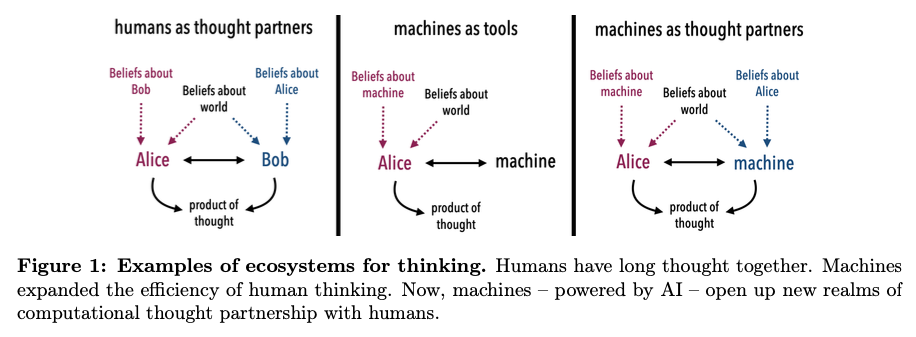
What do we want from machine intelligence? We envision machines that are not just tools for thought, but partners in thought: reasonable, insightful, knowledgeable, reliable, and trustworthy systems that think with us. Current artificial intelligence (AI) systems satisfy some of these criteria, some of the time. In this Perspective, we show how the science of collaborative cognition can be put to work to engineer systems that really can be called “thought partners,” systems built to meet our expectations and complement our limitations. We lay out several modes of collaborative thought in which humans and AI thought partners can engage and propose desiderata for human-compatible thought partnerships. Drawing on motifs from computational cognitive science, we motivate an alternative scaling path for the design of thought partners and ecosystems around their use through a Bayesian lens, whereby the partners we construct actively build and reason over models of the human and world.

Task Allocation in Teams as a Multi-Armed Bandit.
Marjieh, R., Gokhale, A., Bullo, F., & Griffiths, T. L. (2024). Task Allocation in Teams as a Multi-Armed Bandit. https://cocosci.princeton.edu/papers/marjieh2024task.pdf
Abstract
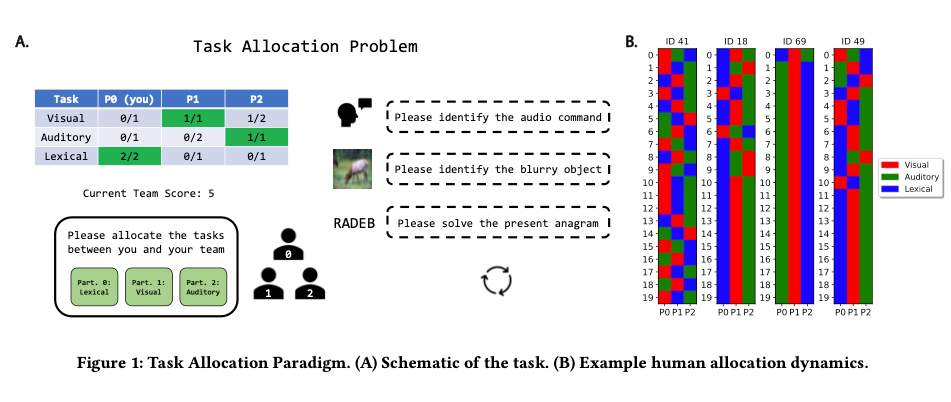
Humans rely on efficient distribution of resources to transcend the abilities of individuals. Successful task allocation, whether in small teams or across large institutions, depends on individuals’ ability to discern their own and others’ strengths and weaknesses, and to optimally act on them. This dependence creates a tension between exploring the capabilities of others and exploiting the knowledge acquired so far, which can be challenging. How do people navigate this tension? To address this question, we propose a novel task allocation paradigm in which a human agent is asked to repeatedly allocate tasks in three distinct classes (categorizing a blurry image, detecting a noisy voice command, and solving an anagram) between themselves and two other (bot) team members to maximize team performance. We show that this problem can be recast as a combinatorial multi-armed bandit which allows us to compare people’s performance against two well-known strategies, Thompson Sampling and Upper Confidence Bound (UCB). We find that humans are able to successfully integrate information about the capabilities of different team members to infer optimal allocations, and in some cases perform on par with these optimal strategies. Our approach opens up new avenues for studying the mechanisms underlying collective cooperation in teams.
Bridging the Gulf of Envisioning: Cognitive Design Challenges in LLM Interfaces
Subramonyam, H., Pea, R., Pondoc, C. L., Agrawala, M., & Seifert, C. (2024). Bridging the Gulf of Envisioning: Cognitive Design Challenges in LLM Interfaces (arXiv:2309.14459; Version 2). arXiv. http://arxiv.org/abs/2309.14459
Abstract
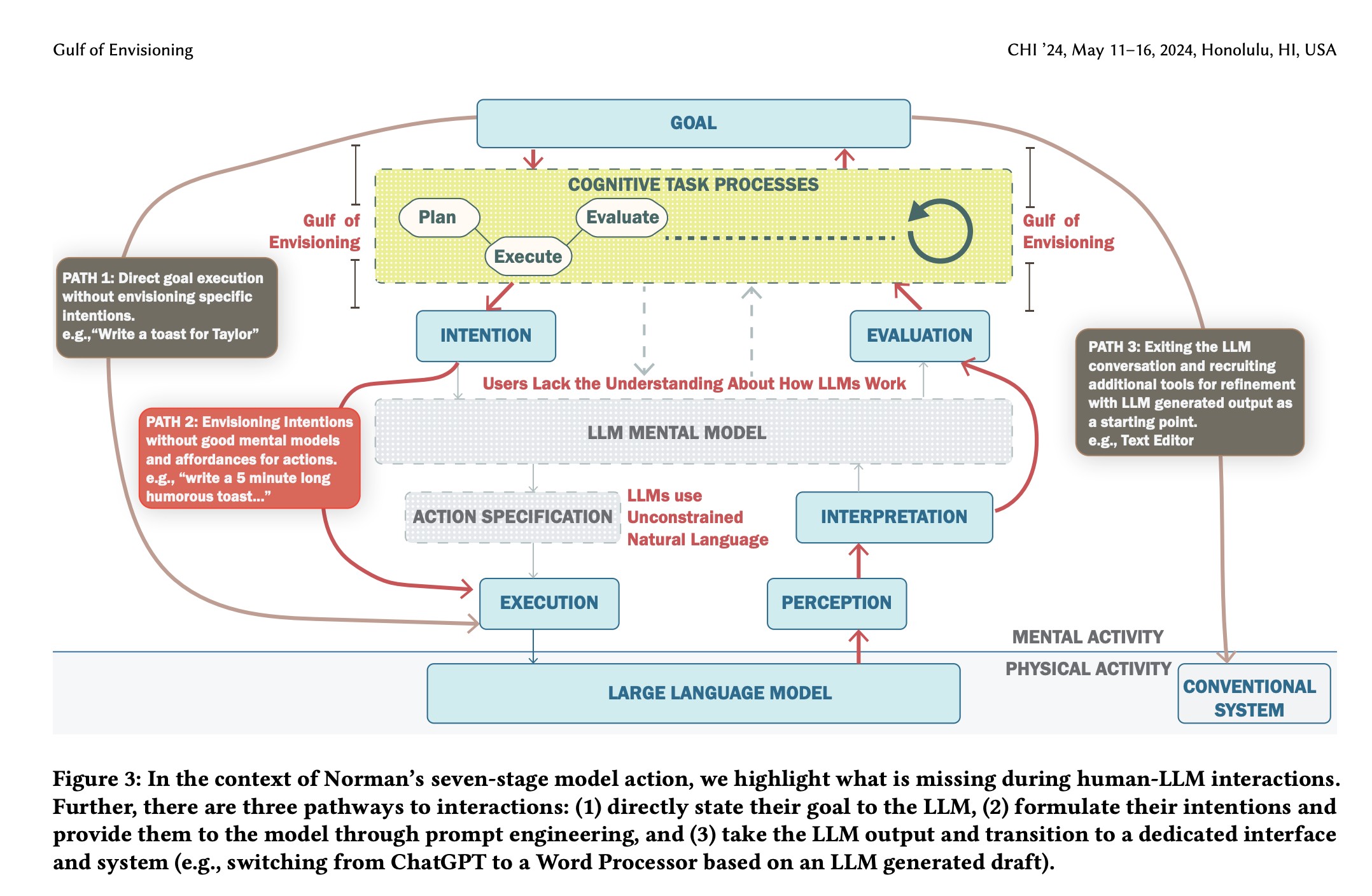
Large language models (LLMs) exhibit dynamic capabilities and appear to comprehend complex and ambiguous natural language prompts. However, calibrating LLM interactions is challenging for interface designers and end-users alike. A central issue is our limited grasp of how human cognitive processes begin with a goal and form intentions for executing actions, a blindspot even in established interaction models such as Norman’s gulfs of execution and evaluation. To address this gap, we theorize how end-users ‘envision’ translating their goals into clear intentions and craft prompts to obtain the desired LLM response. We define a process of Envisioning by highlighting three misalignments: (1) knowing whether LLMs can accomplish the task, (2) how to instruct the LLM to do the task, and (3) how to evaluate the success of the LLM’s output in meeting the goal. Finally, we make recommendations to narrow the envisioning gulf in human-LLM interactions.
Misc Papers
Argote, L., & Ren, Y. (2012). Transactive Memory Systems: A Microfoundation of Dynamic Capabilities. Journal of Management Studies, 49(8), 1375–1382. https://doi.org/10.1111/j.1467-6486.2012.01077.x
Bienefeld, N., Kolbe, M., Camen, G., Huser, D., & Buehler, P. K. (2023). Human-AI teaming: Leveraging transactive memory and speaking up for enhanced team effectiveness. Frontiers in Psychology, 14. https://doi.org/10.3389/fpsyg.2023.1208019
Brandon, D. P., & Hollingshead, A. B. (2004). Transactive Memory Systems in Organizations: Matching Tasks, Expertise, and People. Organization Science, 15(6), 633–644. https://doi.org/10.1287/orsc.1040.0069
Hollingshead, A. B. (1998). Communication, Learning, and Retrieval in Transactive Memory Systems. Journal of Experimental Social Psychology, 34(5), 423–442. https://doi.org/10.1006/jesp.1998.1358
Kimura, T. (2024). Virtual Teams: A Smart Literature Review of Four Decades of Research. Human Behavior and Emerging Technologies, 2024(1), 8373370. https://doi.org/10.1155/2024/8373370
Marjieh, R., Gokhale, A., Bullo, F., & Griffiths, T. L. (2024). Task Allocation in Teams as a Multi-Armed Bandit. https://cocosci.princeton.edu/papers/marjieh2024task.pdf
McWilliams, D. J., & Randolph, A. B. (2024). Transactive memory systems in superteams: The effect of an intelligent assistant in virtual teams. Information Technology & People, ahead-of-print(ahead-of-print). https://doi.org/10.1108/ITP-12-2022-0918
Samipour-Biel, S. P. (2022). A Process Model of Transactive Memory System Shared Knowledge Structure Emergence: A Computational Model in R [Ph.D., The University of Akron]. https://www.proquest.com/docview/2711844070/abstract/DBDAB24DBBB34601PQ/1
Tollefsen, D. P., Dale, R., & Paxton, A. (2013). Alignment, Transactive Memory, and Collective Cognitive Systems. Review of Philosophy and Psychology, 4(1), 49–64. https://doi.org/10.1007/s13164-012-0126-z
Uden, L., & Ting, I.-H. (Eds.). (2024). The Design of AI-Enabled Experience-Based Knowledge Management System to Facilitate Knowing and Doing in Communities of Practice (Vol. 2152). Springer Nature Switzerland. https://doi.org/10.1007/978-3-031-63269-3
Wegner, D. M. (1995). A Computer Network Model of Human Transactive Memory. Social Cognition, 13(3), 319–339. https://doi.org/10.1521/soco.1995.13.3.319
Yan, B., Hollingshead, A. B., Alexander, K. S., Cruz, I., & Shaikh, S. J. (2021). Communication in Transactive Memory Systems: A Review and Multidimensional Network Perspective. Small Group Research, 52(1), 3–32. https://doi.org/10.1177/1046496420967764